Field experiment on eBay
Testing whether response times reveal eBay sellers' evaluations of offers

Collaborators: Ian Krajbich
Tools & Languages: R, python, eBay API
Methods: Data Cleaning, Field Experiment, Linear and Logistic Mixed Effects Regressions
🔭 About
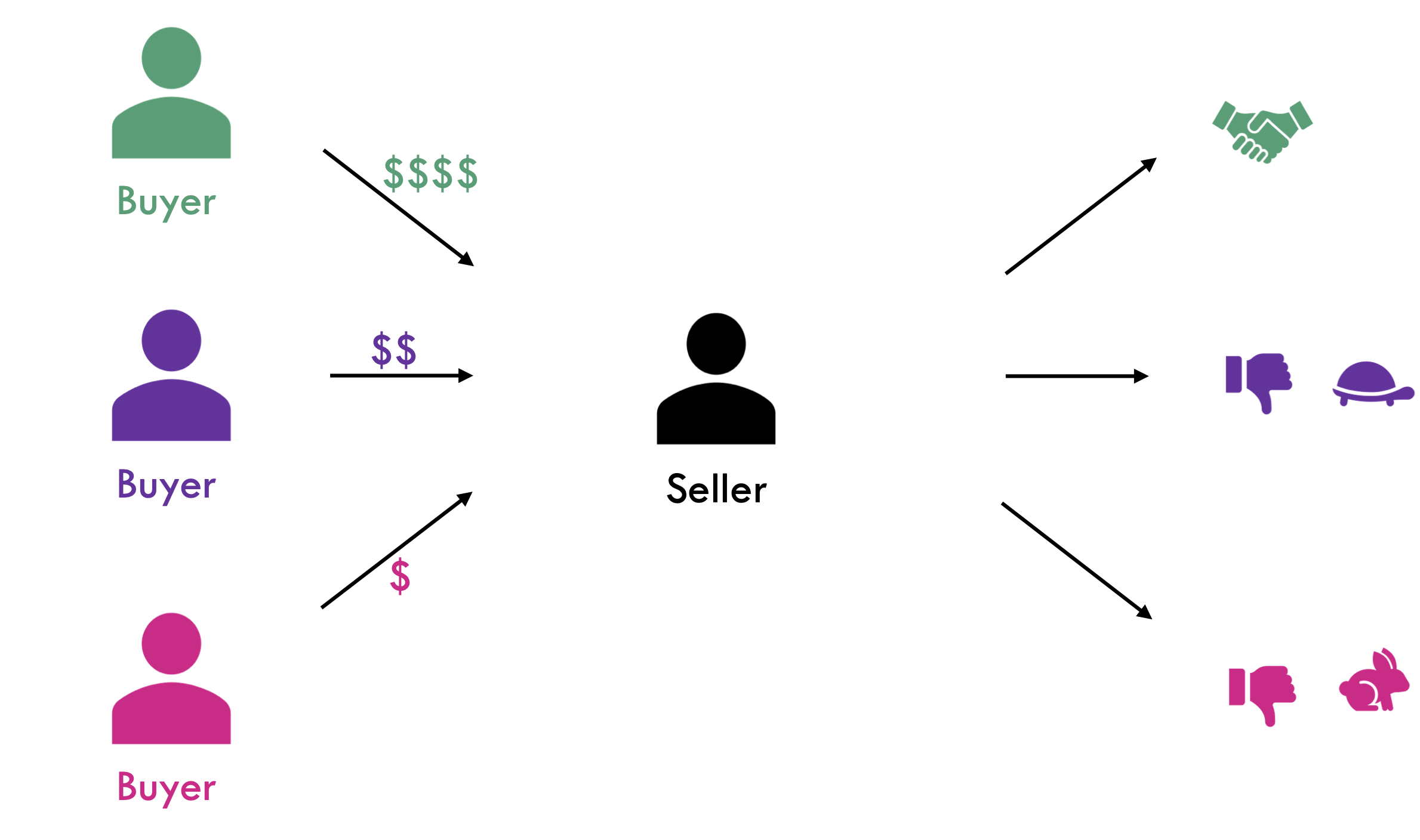
One of my previous projects (eBay observational study) using observational eBay data showed that seller’s and buyer’s response times on eBay varies with how good the offer is, namely responders are fast ( 🐇 ) to reject ( 👎 ) bad offers and slow ( 🐢 ) to reject ( 👎 ) good offers and they are fast ( 🐇 ) to accept ( 👍 ) good offers and slow ( 🐢 ) to accept ( 👍 ) bad offers. Although we controlled for possible confounding factors such as seller and item characteristics, we wanted to know if this results reflected a causal relationship between offer size and response times (RTs). So we decided to run a field experiment on eBay to test this idea by acting as buyers and making random offers to sellers on eBay.
👾 Methods
We ran two waves.
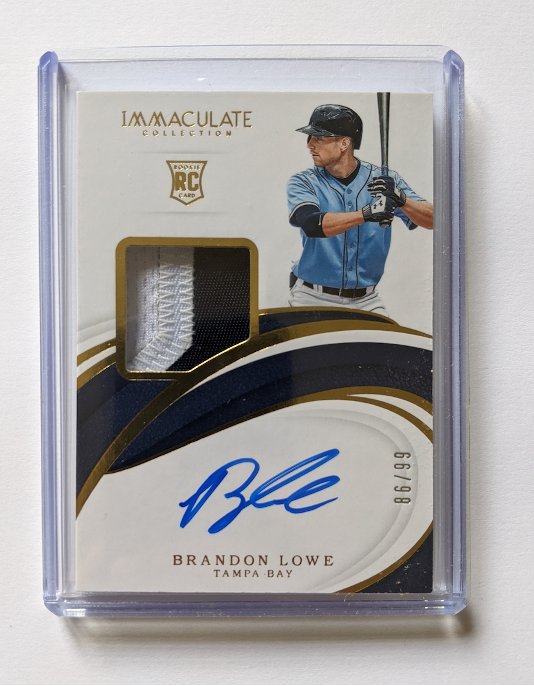
- In the first wave (July–August 2020, during Covid), we targeted 50 sellers with enough items (15–100 listings each). We made 11 offers per seller — each for a different item — at pseudorandom fractions of the list price ranging from 0.3 to 0.9. Items were baseball cards priced between $10 and $20.
- In the second wave (February–April 2023), we scaled up to 150 sellers with 21 offers each, widening the offer range to 0.1–0.8. We also expanded to other collectible cards (Pokémon, Magic: the Gathering, Yu-Gi-Oh, sports cards) — chosen because they are easy to ship, store, and had high bargaining activity on eBay.
This was a within-subject design: each seller received offers at multiple price points, letting us isolate the effect of offer size from unobserved seller characteristics.
We used three different eBay accounts with no prior history, spaced offers so they never overlapped, and sent at most one offer per seller per day.
We also screened out sellers with automatic thresholds by making an initial offer at 50% — sellers who auto-accepted or auto-rejected were replaced.
I used the eBay API to identify items and sellers, retrieve listing metadata, and collect offer outcomes and response times.
🐳 Results
Similar to what we observe in the eBay observational data, we expected that sellers’ acceptance times would decrease with increasing offer size and sellers’ rejection time would increase with increasing offer size.
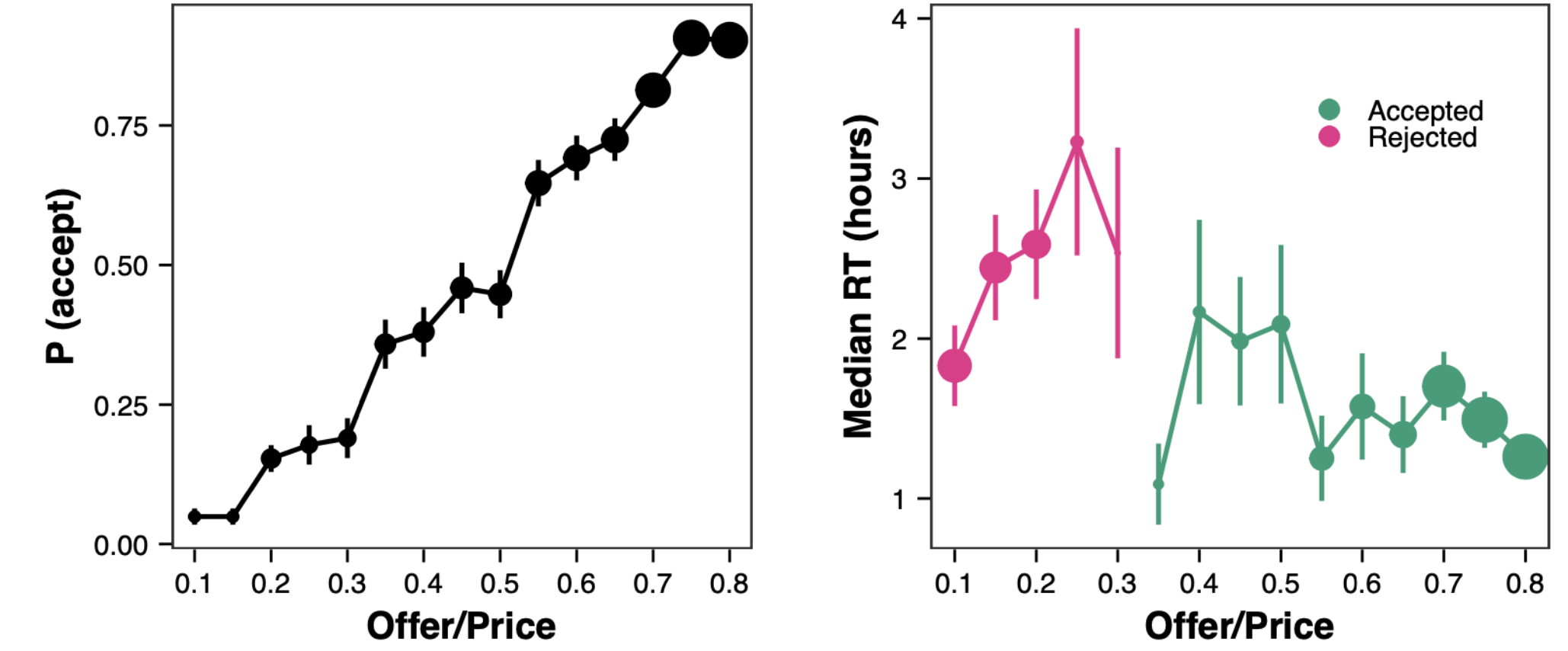
You can read more about this in our PNAS paper.
🌟 Acknowledgements
Undergraduates who helped collect the data with me. From left to right: Astin Lin, Selina Yu, Jocelyn Spanbauer, Vidhur Narayan, Fangzhi Li. Other undergraduates helped me with the first pilot experiment and are not in this picture: Josh Hascher, Katherine Scantling, Alexandrea Howard (high schooler). I couldn’t have done this without them.