Cognitive modeling can identify how people act strategically in negotiations
Using Drift Diffusion Modeling for lab and field bargaining to study how responders strategically manipulate their response times

Collaborators: Ian Krajbich, Wenjia Joyce Zhao
Tools & Languages: R, stan
Methods: Bayesian Statistics, Model Comparison, Sequential Sampling Models, Supercomputing Resources
🔭 About
Many decisions involve a process of comparing and accumulating net evidence in favor of the choice options up to a predetermined boundary, a process which takes time and reflects the strength of the net evidence. The evidence reflects the agent’s evaluation of the choice options – an agent deciding between an apple ( 🍎 ) and an orange ( 🍊 ) must weigh the benefits and costs of the apple against those of the orange.
If these two evaluations are roughly equal ( 🍎 ~ 🍊), the agent will struggle to decide which item to choose ( 🐢 ). On the other hand, if the agent finds the orange to be much more attractive than the apple ( 🍊 > 🍎 or 🍎 > 🍊), then their choice will be quick and predictable ( 🐇 ).
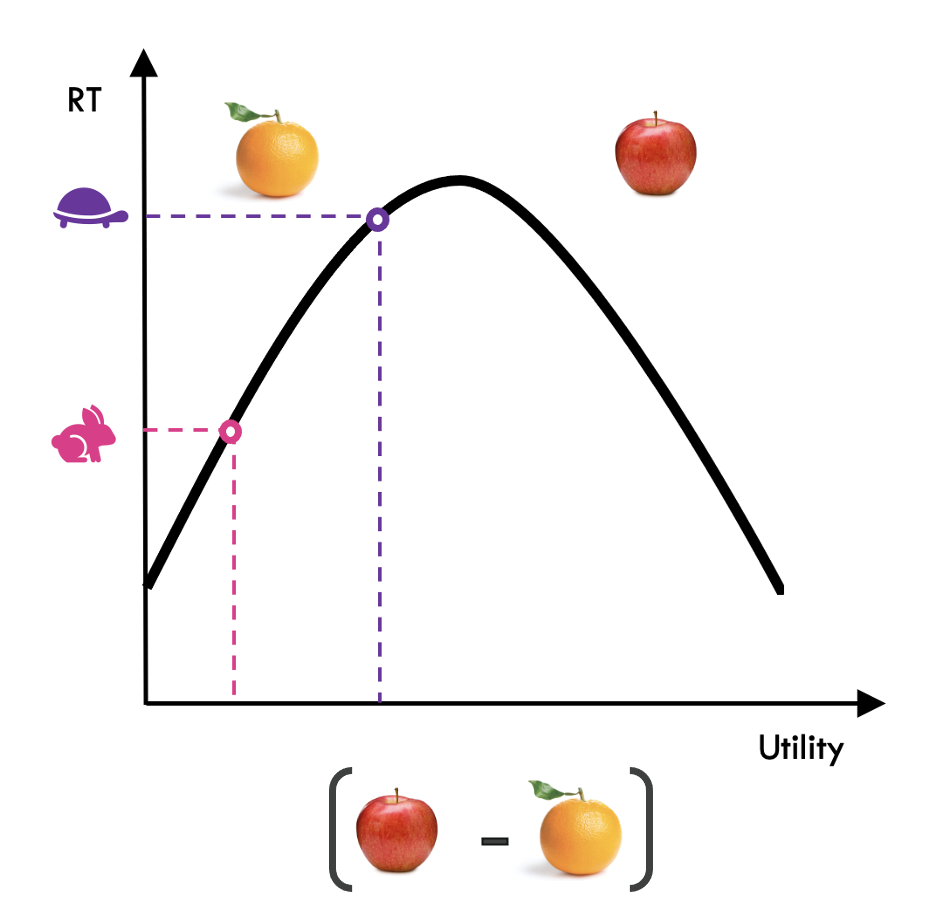
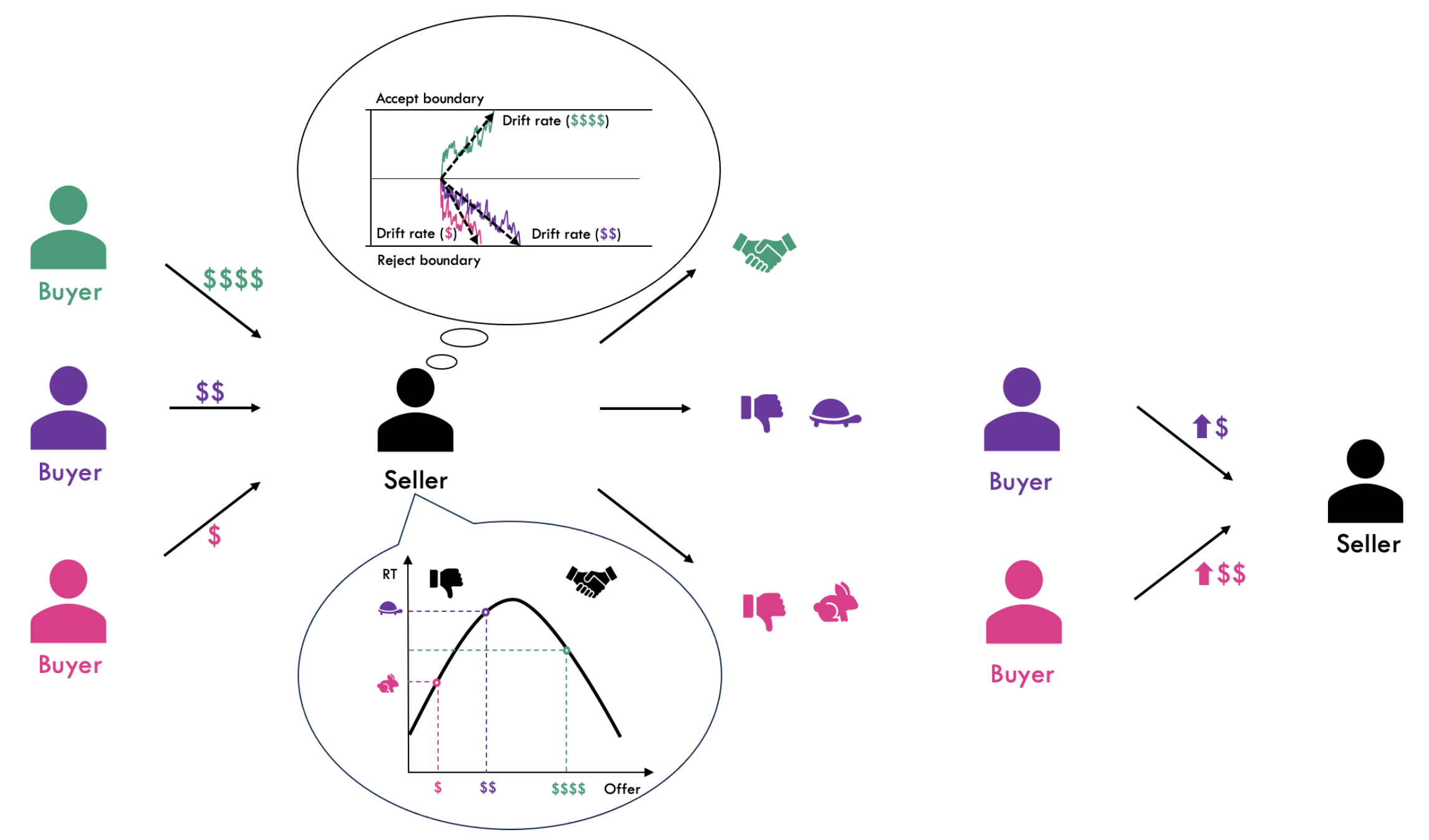
In the bargaining example, the seller must weigh the buyer’s offer against the utility of the car and/or future offers. If the seller rejects ( 👎 ) the buyer’s offer quickly ( 🐇 ), they signal to the buyer that the offer was far too low; if the seller rejects ( 👎 ) the offer slowly ( 🐢 ), they signal to the buyer that the offer was competitive.
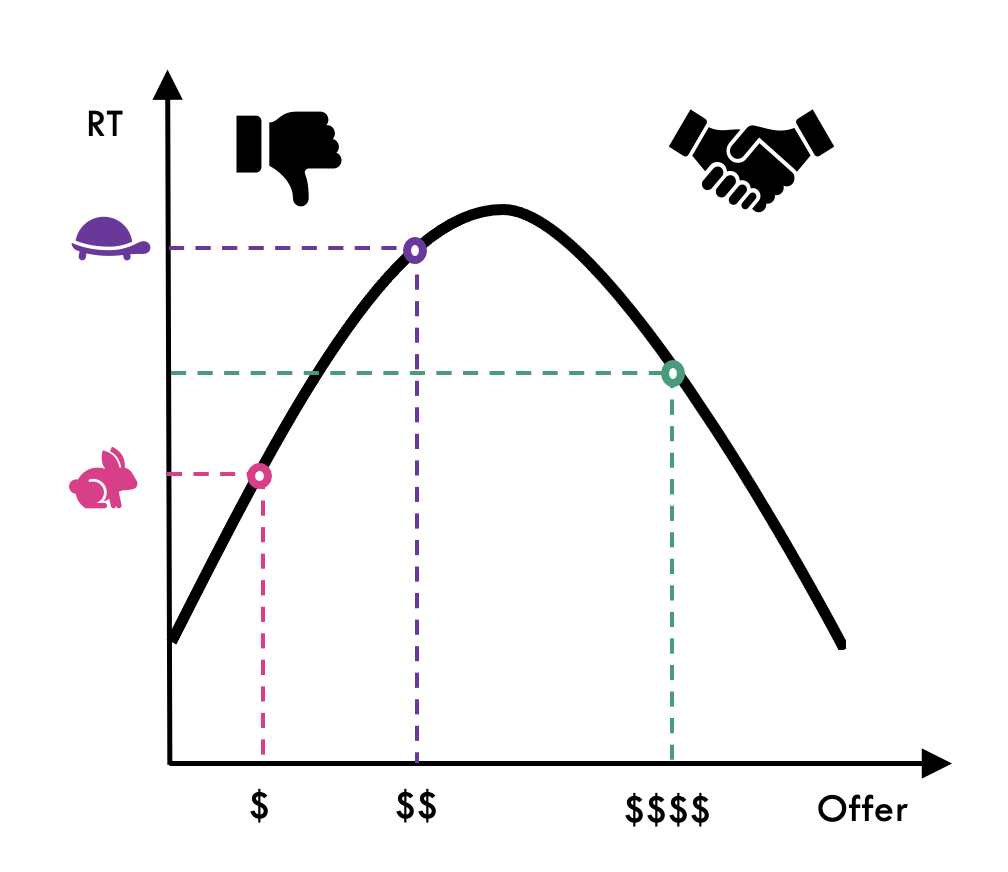
This relation between strength-of-preference and response time (RT) is a basic feature of evidence-accumulation or sequential-sampling models, such as the drift-diffusion model (see below). In this project we wanted to know if this model can account for lab and observational bargaining behavior. Do proposers in the lab who know their response time is being observed try to manipulate it int order to signal higher values? Do sellers with more experience on eBay have a different bargaining strategy than sellers with less experience?
👾 Methods
Drift Diffusion Model
The basic assumption of the Drift Diffusion Model is that decision-makers sample evidence for one option over the other until one of the decision boundaries is hit. This process takes time and reflects the person’s evaluation of the choice options.
In bargaining, for a specific value for the item and offer, one decision boundary is choosing to accept the offer, the other to reject it.
Different values on the y-axis are associated with different preference states between the two options. The x-axis represents the timeline of a single decision.
After an offer is made, the responder weighs the size of the proposer’s offer against the value of their good and possible future offers, and they make a decision as soon as one of the decision boundary is hit.
Parameters in the DDM:
- the starting point bias (z) represents the preparation process
- the drift rate (v) represents the evaluation process
- the decision boundary (a) represents the caution level
- the non-decision time (t) represents motor or processing delays
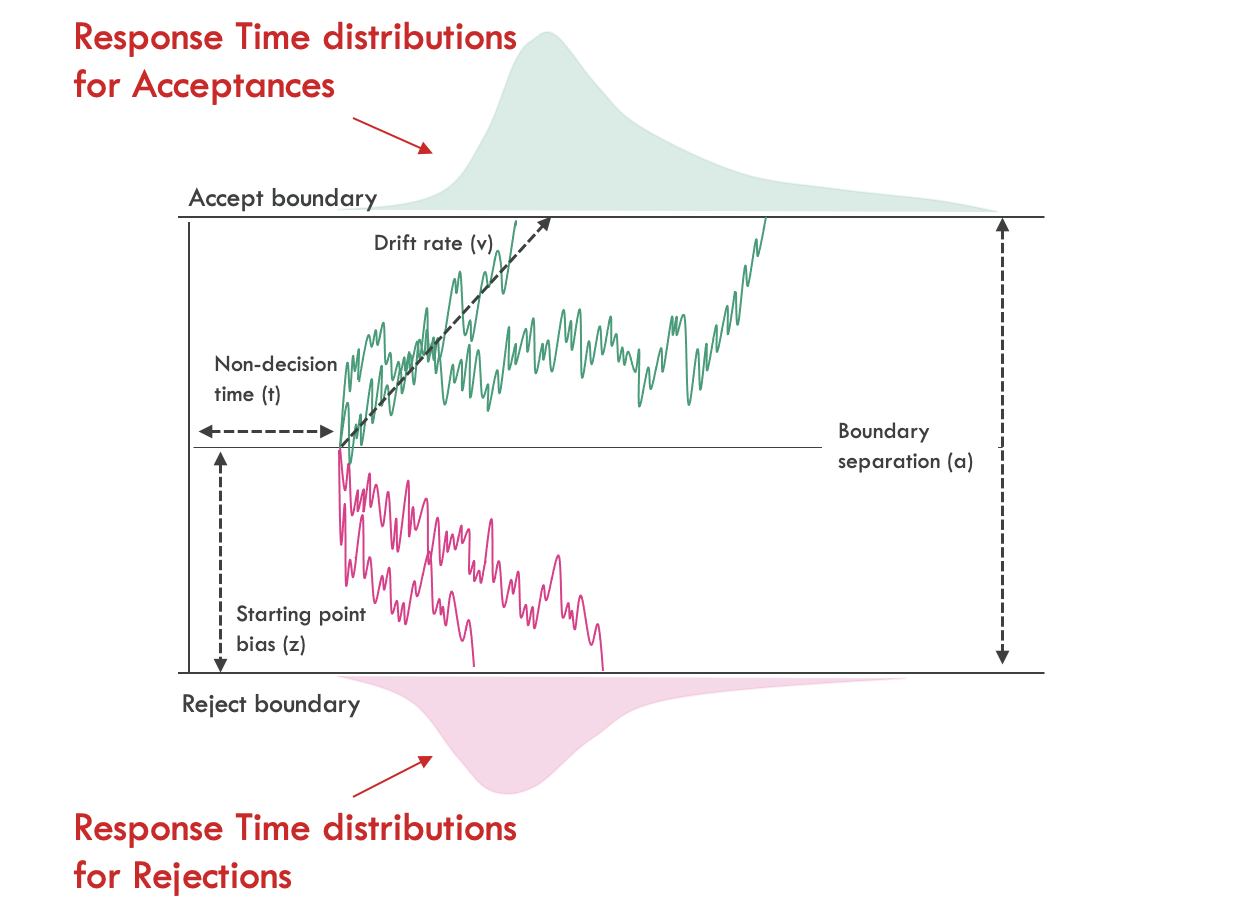
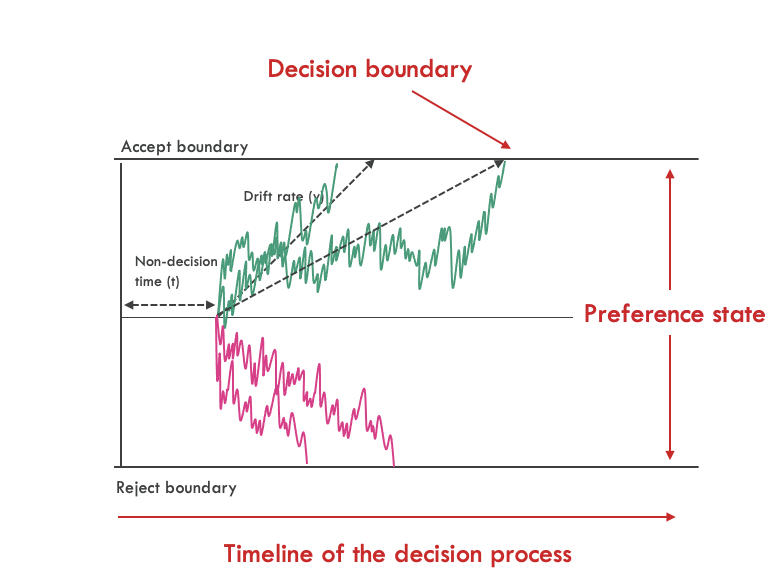
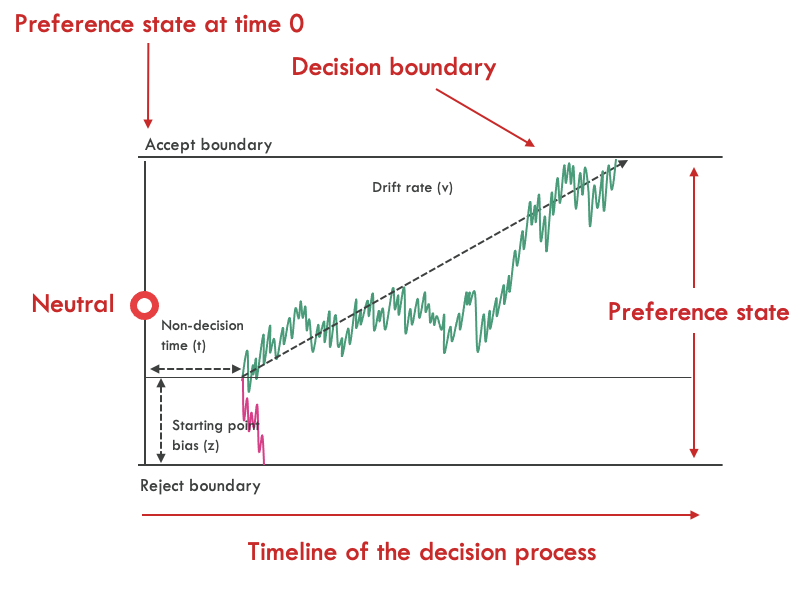
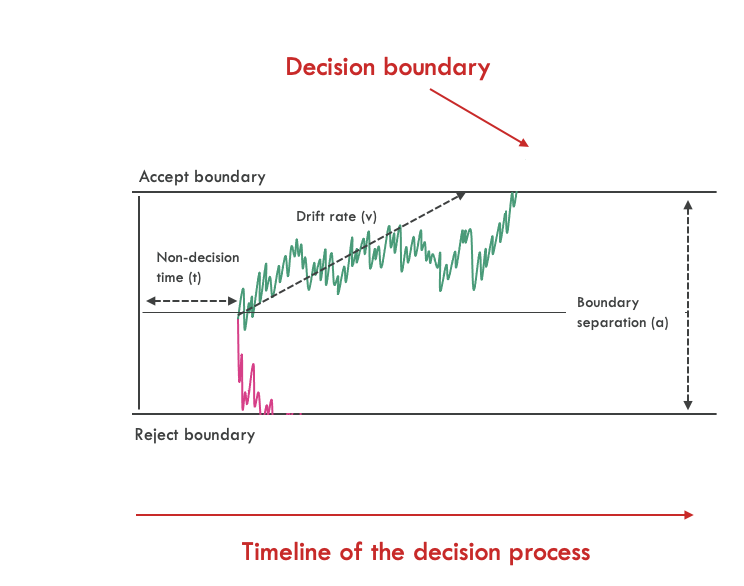
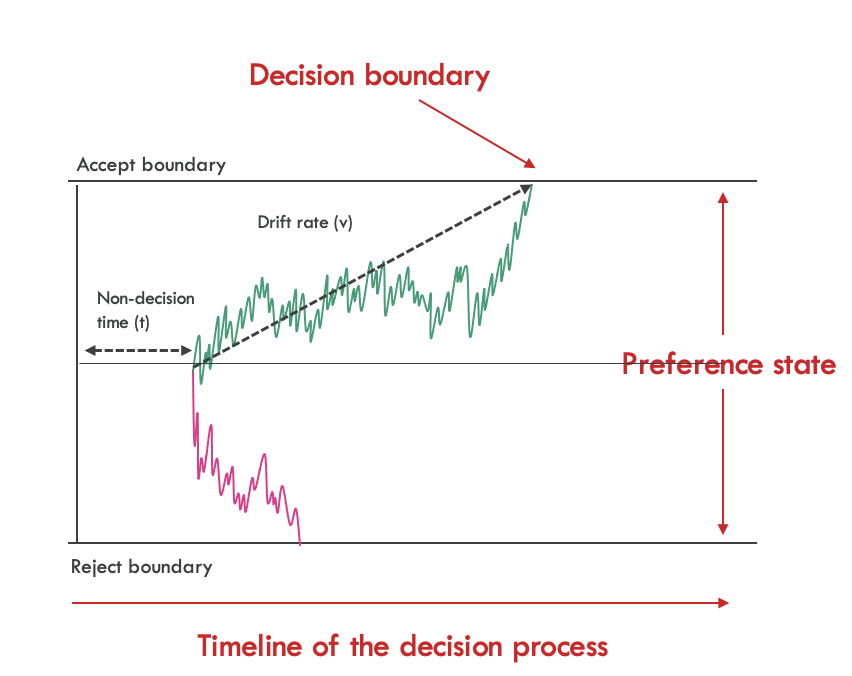
Changes in the parameters will produce behavioral changes such as changing choice probabilities and response times. Moreover, changes in parameters help us infer which cognitive processes change with our experimental manipulation or with individual characteristics such as experience.
DDM in bargaining
Agents who do not have prepared strategies must make decisions on the spot, likely employing a DDM-like process. In that case, their RT’s might reveal their private information, putting them at a strategic disadvantage. In the bargaining example, the seller must weigh the buyer’s offer against the utility of the car and/or future offers. If the seller rejects the buyer’s offer quickly, they signal to the buyer that the offer was far too low; if the seller rejects the offer slowly, they signal to the buyer that the offer was competitive. A strategic buyer, noting the seller’s RT, should respond with a large offer increase in the former case but only a small offer increase in the latter. Therefore, a partially strategic seller would want to reject as quickly as possible, to get the largest possible offer increase from the strategic buyer. However, quick decisions come at a cost – they entail a higher chance of mistakenly rejecting a good offer or accepting a bad offer.
Research question
The DDM is typically applied to fast perceptual judgments, but in recent years it has seen increasing application to economic choice. However, it has yet to be applied to strategic settings where RT might betray private information. It has also not been applied to decisions longer than a few seconds. Here, we fit the DDM to both the lab and eBay bargaining data to see how well it can quantitatively explain the choice and RT data and to better understand how agents’ decisions might change when RT is a strategic variable.
Lab experiment
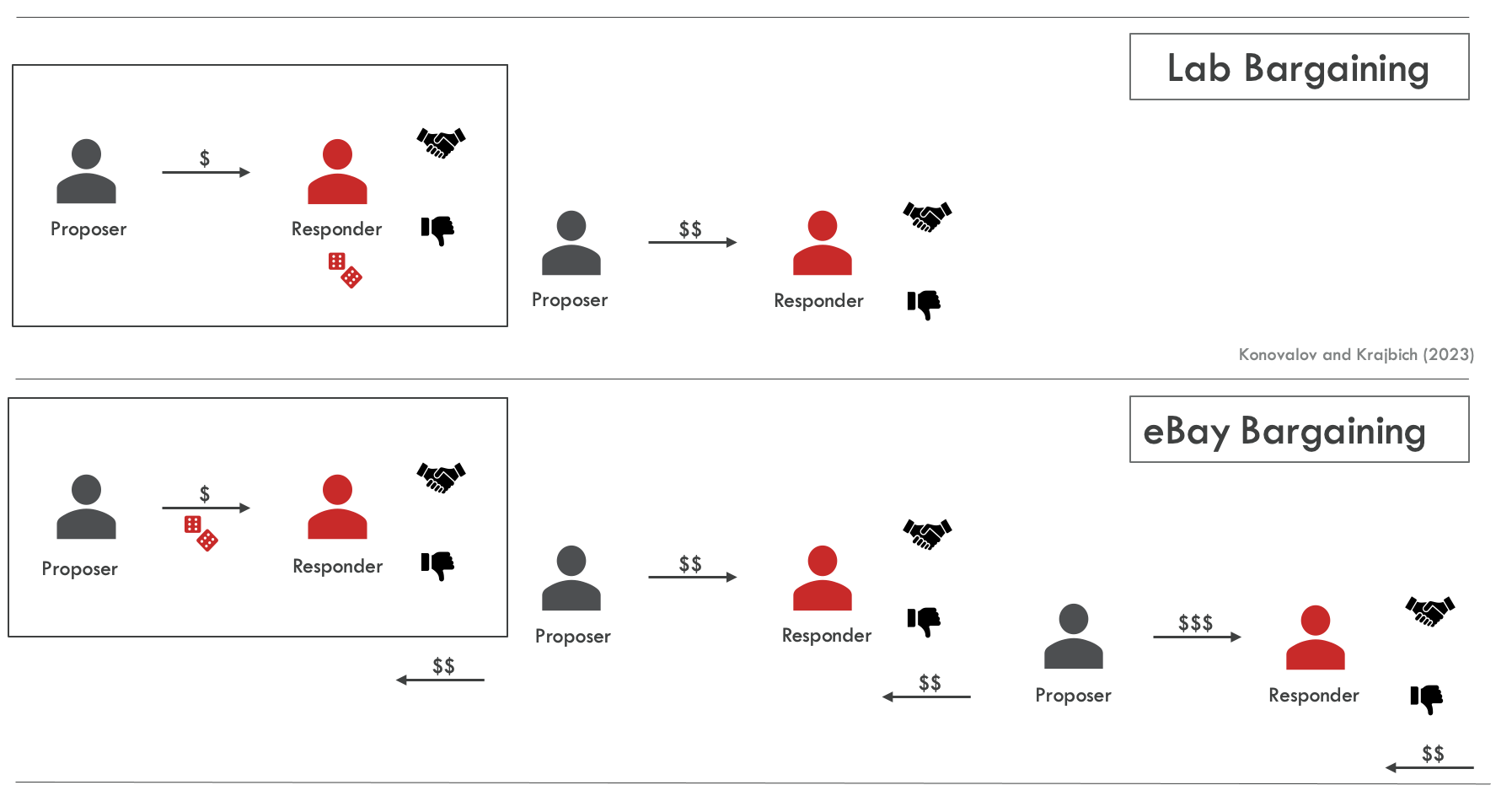
In the lab experiment of Konovalov and Krajbich (2023), each responder was randomly assigned a private value from 0 to 100 for a voucher owned by their assigned proposer. The voucher was worthless to the proposer; their implicit goal was simply to extract the highest possible price from the responder. The proposer set an initial price from 0 to 100, which the responder could accept or reject. If the responder rejected the offer, the proposer could try again with another price, but both the responder’s and proposer’s profits from a sale shrank by a constant factor in this case. As in real bargaining, the subjects had to weigh the costs and benefits of delaying (or preventing) a trade by either setting the price too high or rejecting an acceptable offer. There were two conditions in the experiment, with the responder’s RT either Hidden or Visible to the proposer. As with the eBay data, we focus exclusively on behavior in response to the first offer.
eBay bargaining
Our field setting is eBay – one of the world’s largest online marketplaces. Since 2005 eBay has allowed people to sell their products through an alternating-offer protocol where sellers post items for sale and buyers can make them offers. eBay recently released a dataset with millions of bargaining exchanges from June 2012 to June 2013 (Backus et al. 2020). We analyze 20% of that data, leaving the rest for future validation. We focus on buyers’ initial offers and sellers’ responses to those offers. A seller can accept, reject (including letting it expire), or counter an offer.
🐳 Results
Lab DDM
We found that the DDM provided an accurate quantitative account of the responders’ behavior in the lab experiment. We found that the drift rate in the DDM was a linear function of the responder’s value minus the proposer’s initial price (i.e., the responder’s surplus). As a result, a responder’s probability of accepting an offer was increasing in their surplus, both in the data and in the model.
Like the eBay data, a responder’s RT was increasing with surplus for rejections but decreasing with surplus for acceptance, both in the data and model.
The DDM also revealed interesting differences between the Hidden and Visible RT conditions. Responders were significantly faster to respond in the Visible condition, particularly for rejections.
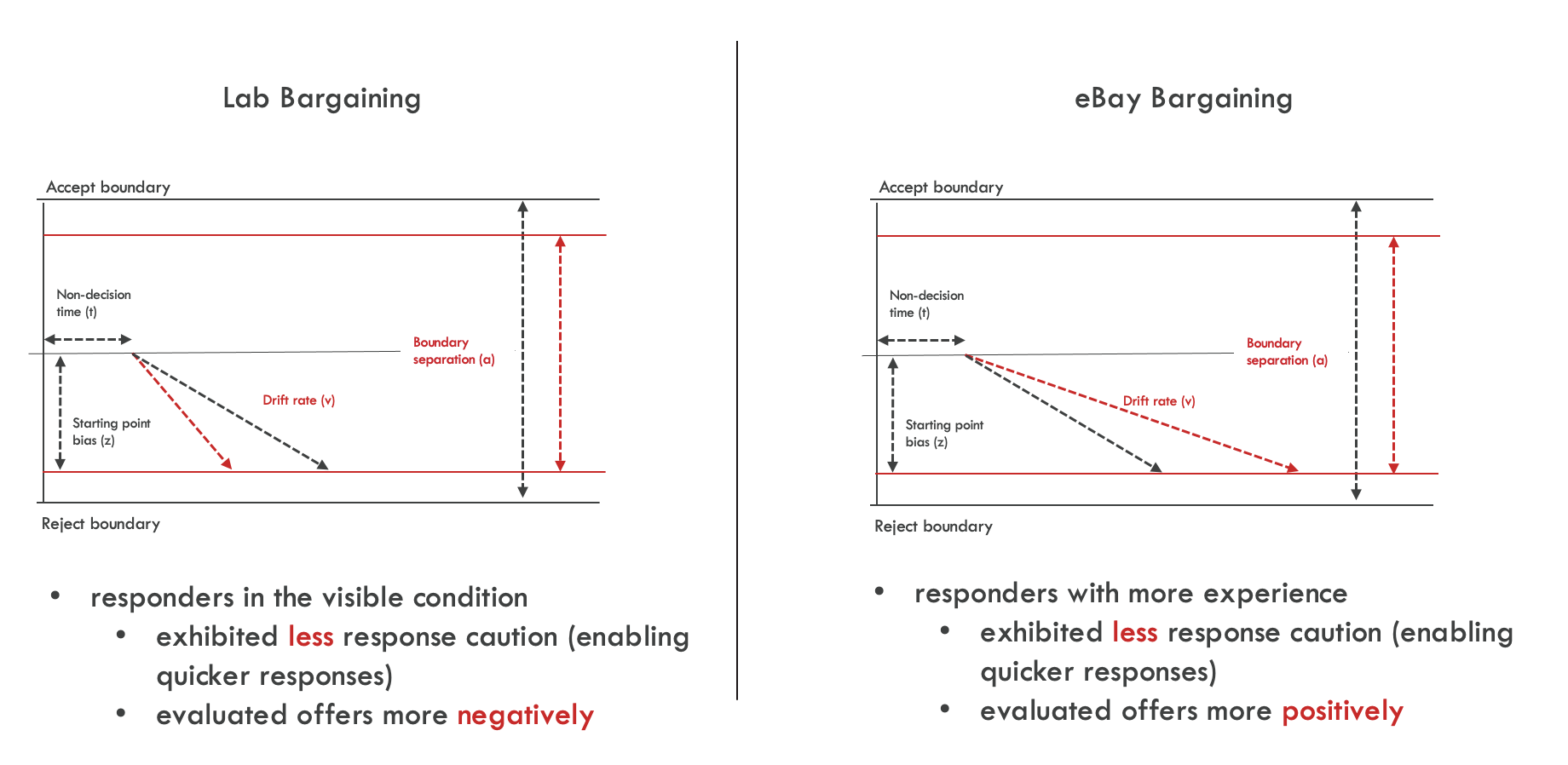
To compare the conditions with the DDM, we allowed non-decision time, boundary separation, starting point, and the drift-rate function to vary between conditions. We observed two noticeable differences between conditions. responders in the Visible condition exhibited a marginally narrower boundary separation (group posterior differences Visible - Hidden M = -0.443, HDI = [-0.92, 0.097]) and a credibly more negative drift-rate bias (group posterior differences Visible - Hidden M = -0.405, HDI = [-0.673, -0.157]). In other words, responders in the visible condition exhibited less response caution (enabling quicker responses), and evaluated offers more negatively, increasing the speed of rejections.
eBay DDM
The DDM also provided an accurate account of sellers’ behavior on eBay, with some caveats. Unlike in the lab, eBay users are not constantly monitoring their accounts and thinking about how to respond to offers. Sellers may take hours before seeing an offer and their decision process might be interrupted by sleep, work, family, etc. These delays and interruptions are non-decision time. Standard DDM’s account for non-decision time with a uniform random variable. Therefore, we developed more complex models of non-decision time that use Gamma distributions (Model 2), include the time of day (Model 3: sleep and work), and vary with the quality of the offer (Model 4: more interruptions when sellers struggle to decide).
These additions to the DDM substantially improved model fit for many sellers. We compared these models using Watanabe-Akaike Information Criterion (WAIC), a standard method for comparing model fit while accounting for model complexity. Relative to the model with the standard nondecision time specification (Model 1), Model 2 improved model fit for 11% of sellers, Model 3 further improved model fit for another 47% of sellers, and Model 4 even further improved model fit for 42% of sellers.
Using the best-fitting non-decision-time model for each seller, the DDM could accurately capture both choice and RT data from the eBay sellers (at least those that fit our inclusion criteria) namely the fact that sellers respond to higher offers with a higher probability of acceptance, faster acceptances, and slower rejections.
While there is no eBay equivalent to the Hidden condition in the lab experiment, we can examine how sellers’ choice processes are affected by their experience, under the assumption that more experienced sellers should be more aware of the strategic nature of RT. We measured experience by the number of bargaining exchanges sellers have participated in before the current offer. When examining RT as a function of the offer size for more experienced sellers, we observed a speeding up of that function for acceptances, but not for rejections. Looking at correlations between DDM parameters and experience, we found that seller experience is negatively correlated with boundary separation (like the lab data) and positively correlated with drift-rate bias (opposite to the lab data). More experienced eBay sellers exert less response caution and evaluate offers more positively.
Summary of DDM Results
🏁 Conclusions
In the lab, we found that subjects who knew their RT was being observed evaluated offers more negatively during deliberation, and also exhibited less response caution overall – enabling quicker responses but at the cost of making more mistakes. Both findings are consistent with a strategic manipulation of RT idea.
In the eBay data, we also found that more experienced sellers exhibit less caution in their choices and are more likely to accept a given offer.
A commonality between the two setting was a lowering of the boundary separation: both when RTs were visible compared to hidden in the lab and when sellers had more experience on eBay. More experienced sellers are perhaps less cautious because they are involved in more bargaining threads and so cannot afford to spend as much time on any one offer. We also suspect that they are more likely to accept a given offer because they are less attached to their goods. Indeed, professional sellers are less likely to exhibit the endowment effect.
You can read more about the modeling of the eBay data in our PNAS paper.